Extinction
H is for HawkExtinction in the book is not simply the final disappearance of a species. It is also a change in how animals can be known: as living, resistant presences, or as images whose meanings have narrowed to rarity and loss. Through the California condor, the Spix's macaw, the Myxomatosis epidemic, and the altered countryside, the narrator traces how biological decline becomes a crisis of memory and attention. The return of goshawks to Britain complicates the picture, showing that human influence can contribute to wild life as well as diminish it.
Extinction made into an image
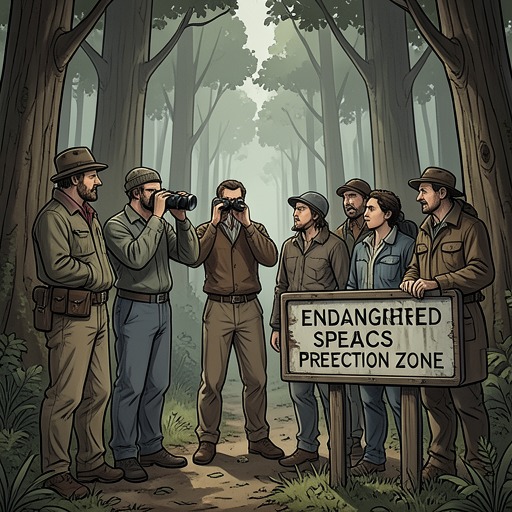
At an exhibition, the narrator enters a full-sized bird hide constructed inside a gallery. A film projected beyond its window shows a California condor soaring from a real hide in California. The setting makes spectatorship part of the exhibit: visitors peer from an imitation hide at an image of a bird whose wild population had been devastated by persecution, habitat destruction, and lead poisoning. By the late 1980s only twenty-seven remained. In an effort to save the species, conservationists captured the remaining birds so that young bred in captivity could be used to repopulate the wild. Some opposed the plan, fearing that captivity would mean the end of the condor as a wild animal.
The screen image leaves the narrator impatient, in part because it cannot reproduce the particularity of live condors remembered from a captive-breeding centre. Those birds had appeared curious and individual; the projected condor instead becomes an icon of extinction. The distinction is not between a simple failure and a simple success in conservation. It is between an animal encountered as a complicated living presence and one encountered at a distance through a representation that concentrates attention on its threatened status. As animals become rarer, the narrator argues, the range of meanings people can attach to them contracts. The condor risks becoming legible chiefly as the last of its kind, and the world is diminished when its creatures are reduced to signs of loss.
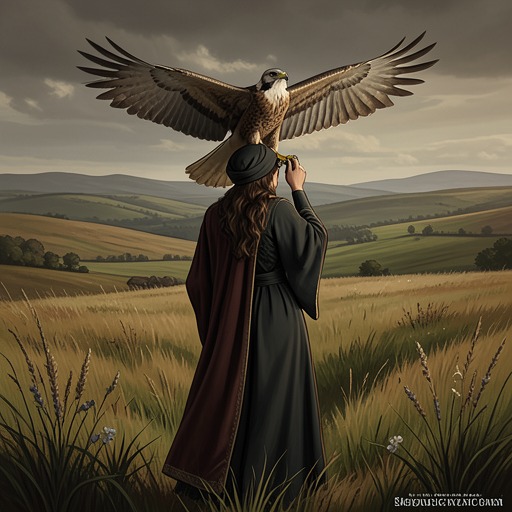
The narrator sets this mediated encounter against life with Mabel, whose behavior resists any single human interpretation. A hawk incorporated into a human life remains an animal with its own responses, not merely an emblem. The difference matters to the narrator’s understanding of care: attachment and knowledge grow through contact with an individual animal, while an image on a screen can make extinction both visible and abstract. The Spix's macaw in the same exhibition sharpens that tension. It lies dead in a glass case, its species absent from the wild and its remaining captive birds the focus of urgent efforts to preserve it. The narrator’s response to the specimen turns toward the remembered death of a father, bringing extinction into contact with personal bereavement without making the two losses interchangeable.
Epidemic, memory, and fear
A sick rabbit on a roadside connects present-day animal suffering with a much larger history. The narrator finds it after walkers have stopped to watch, concerned but unsure how to intervene, and puts it out of its misery. The rabbit has Myxomatosis. The disease reached Britain in 1952, and within two years the virus had killed 95 per cent of the rabbit population. Tens of millions of dead rabbits lay across roads and fields. Their disappearance altered the countryside: grasslands once kept short by grazing grew into scrub, and predator populations fell. Rabbits later recovered, but not to the numbers people had once treated as normal; outbreaks continued even as the virus became less virulent.
The roadside rabbit returns the narrator to childhood, when environmental decline felt like a general crisis rather than a single species’ misfortune. Alongside dying rabbits were declining hawks affected by agricultural pesticides, dead or felled elms, vanished otters, poisoned rivers, and guillemots in oil-contaminated seas. The narrator’s childhood fear of nuclear destruction joined these losses into an expectation that everything might be destroyed. When the child asked whether the family could build a fallout shelter, the parents explained that the house was near military targets and that survival would be unlikely in a nuclear war. The child buried pieces of slate bearing a name, imagining that they might outlast the catastrophe. The later encounter with the rabbit revives not only recollection but the earlier state of mind in which ecological damage and human annihilation seemed part of the same future.
The book treats this recovery of memory as uneven. A sick rabbit can draw the past into the present, just as rereading J. A. Baker’s account of watching peregrines brings back a vision of a world already dying. The narrator contrasts that vision with T. H. White’s attachment to small things and his hope for miracles, while recognizing that both writers’ hawks carry human histories. The question is not whether a hawk simply represents life or death, but how prior experience shapes what people believe they see in it. The narrator hopes that Mabel’s living presence can mean life, while knowing that hope does not undo the histories of decline that gather around wild animals.
Landscapes that conceal loss
The book places extinction within landscapes that remain recognizably rural. In fields farmed organically near Cambridge, the narrator finds abundant life; elsewhere, fields may look much the same at a glance while supporting few plants, bees, or butterflies. The soil there is treated with chemicals, and successive absences mark the altered land. Turtle doves were present ten years earlier; corn buntings and large flocks of lapwings thirty years earlier; red-backed shrikes, wrynecks, and snipe seventy years earlier; ravens and black grouse two centuries earlier. The sequence makes loss measurable through remembered and recorded changes, rather than through the appearance of a single devastated scene.
This contrast unsettles the nostalgic idea of an enduring English countryside. What people call Old England, the narrator argues, is an imagined landscape assembled from cultural pictures and inherited descriptions. Such images can make a place seem continuous even as its life changes. People struggle to perceive ecological scale: small organisms may seem negligible, while climate change exceeds ordinary imagination; a human lifetime is too short to remember what lived in a place before, or to picture what will be absent after it. The result is a shifting baseline in which a diminished landscape can still appear normal because earlier abundance has dropped out of living memory.
The history of Breckland offers a more explicit account of human forces reshaping land. Neolithic flintworking left stone fragments in the soil; later, extensive rabbit warrens and sheep grazing stripped vegetation from the sandy ground. In 1688, strong winds drove the exposed sand across the region, burying settlements and choking a river. The landscape’s strangeness is therefore not evidence of untouched wilderness: it bears the consequences of industry, grazing, disaster, forestry, and work. Its layered history makes a neat opposition between human presence and nature untenable.
Return, responsibility, and the limits of repair
The extinction of goshawks in Britain and their later return provide a counterpoint to irreversible loss. Goshawks once bred across the British Isles, but land enclosure restricted ordinary people’s access to falconry, firearms displaced hawking as fashionable sport, and persecution by gamekeepers compounded habitat loss. By the late nineteenth century, British goshawks were extinct. In the 1960s and 1970s, falconers began an unofficial scheme: for the cost of importing a bird for falconry, they could bring in another and release it. Birds from Sweden, Germany, and Finland were released or lost, survived, found mates, and bred. Their descendants eventually numbered about 450 pairs.
That recovery does not make human intervention innocent or guarantee that damaged species and habitats can be restored. It does show that wildness is not always separate from human action: the returning goshawks established themselves in forests, and their presence challenges the assumption that anything shaped by human hands must be less wild. The book holds this possibility beside less reversible absences, including the vanished birds of chemically treated fields and the rabbit population transformed by an introduced virus.
The narrator’s account therefore joins conservation to the work of remembering. A species can disappear from a habitat, remain visible as a specimen or screen image, and continue to shape how people imagine nature. Those forms of survival are not equivalent to a living population, just as a familiar-looking countryside is not proof of an intact ecosystem. Extinction matters not only because individual species vanish, but because each disappearance narrows the living world and makes its earlier abundance harder to recognize. Against that narrowing, attention to particular animals, places, and histories becomes a form of responsibility: it resists treating loss as the natural background to an otherwise unchanged landscape.